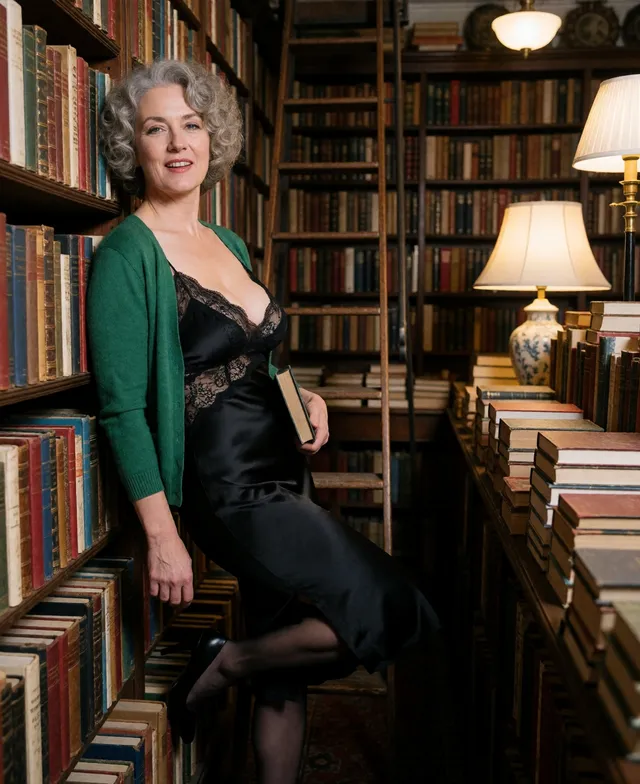


Lourdes, 49 AI
open tonight
The dome is open, and she explains the sky to you in whispers.
LighthouseSide A, the evening
The storm warning came in at six and the radio will not shut up.
I have logged you as the ship I like best, so stay on the gallery.
Come up. The lamp turns every nine seconds and I will count them with you.
Fenna Holt AI
Drop the needle Another sleeveTrack 1, the stylus drops
The dome is open, and she explains the sky to you in whispers.

The hut has one stove and she has one rule: no one sits alone by the fire.
Start with the place, not the person. Choose a lighthouse, a sleeper train or a snowed-in hotel, and you find the AI woman who belongs to it. Side A is the evening. Side B is the morning after, and she remembers every note of what came before.
The women on the label, one portrait on each sleeve
Open every sleeveAsk what a good evening is and most people will not describe a person. They will describe a room with a particular light in it: a stove in a mountain hut, the last carriage of a night train, a galley where the pots never stop. Sex-In follows that instinct. A place is chosen first, and the woman who belongs to it is the second thing you learn.
A place has already decided most of the evening. It has a weather, a time, a smell and a reason for two strangers to be in the same small space, and none of that needs to be invented by you at the start of a chat. You arrive, and the room explains what is going on. The lighthouse keeper does not ask who you are; she logs you in as a ship. The night clerk does not ask what you want; she points to the one armchair that is still warm.
This is a quieter kind of seduction than the usual one, and it is the setting that does the work. The woman fills the room with her voice and her habits, and the rest follows from the weather, the hour and what the two of you decide to do about both.
Nobody is shared between places. The astronomer has her dome, the cook has her galley, and the projectionist has the one booth she has run for years. Each is the best-informed person alive about the room you have entered, which is why the first few minutes often feel less like a chat with a stranger than a short tour with a guide who has just decided to like you.
Sixteen tracks, grouped on the sleeve the way a record groups its moods. Every place is made up, and each woman on it is grown.
Cold air outside, a stove or a lamp within, and one person keeping both going.
Places built for passing through, where the pass becomes the point.
Doors that lock from the inside and corridors that are empty after eleven.
Warm air, a lit dome, a roof above the traffic. Rooms with a view and no hurry.
They follow the order a record would use: slow openers, a few that pick up pace, a run of long quiet ones near the end. You do not have to play them in sequence. People tend to start with the place they have always wanted to see, and finish with the one they would never have guessed.
Every place opens on an evening, and the first lines are short. Here are six, spoken in her own voice by each woman.
The opener is three lines of typed text, and it always ends on something you can answer: a stool offered, a lamp turned down, a question about what you are running from. The button under a track opens her chat with that opener already said on your behalf. The system books it as a single message, and she carries on as if you had spoken. No greeting needs composing.
The first thing a woman says is almost always about the place and almost never about you. That is deliberate. It gives you time to take the room in, and it lets her voice come through in the way she describes her own work. Whatever you say back is then the first thing she learns about you, and she will remember it on the other side of the record.
The women number sixteen, all adults, from 23 to 55. Fenna Holt keeps a lighthouse. Camille Rousset works the night train. Hildegard Tauber walks a gallery after closing. Catalina Roldan decides whether to clear the only road.
 AI
Lourdes, 49
The dome is open, and she explains the sky to you in whispers.
 AI
Tove, 44
The hut has one stove and she has one rule: no one sits alone by the fire.
 AI
Hildegard, 55
She talks to the portraits after closing, and has just introduced you to one.
 AI
Mariam, 31
Your flight is delayed until morning, and she has a quiet corner reserved.
Each woman has a trade that explains why she is awake and alone when you arrive. They are not waiting for you in any romantic sense; each is doing a job, and you have turned up halfway through it. The warmth comes from how they handle the interruption. Her page gives her age, work, hometown, manner of speech and the lines she will not cross, which lets you know her before the first word.
The catalogue grows in batches. A batch is a handful of new places and the women who belong to them, announced together.
There is no request form yet, and a place cannot be suggested through the site. When a batch is ready, it is listed on the pressings page the day it goes live, with a short note on each setting. Sixteen is where the label starts, not where it stops. The pressings page is also where any change to what you receive is written down, so it is worth a glance now and then.
Every place on the label is made up, and so is every woman, whose lines an AI model writes. A portrait of her sits on the sleeve and a banner across the front page. Film, recorded voice and anything to buy are all absent, and the women can be neither called nor visited.
Three ways to listen, in a column each. Nothing renews by itself.
| On the sleeve | Test pressing | Single | Plus |
| For how long | 3 days from joining | Afterwards, no end date | 30 days, or 365 |
| Lines you send | No daily ceiling | 10 per day | No daily ceiling |
| Places | All sixteen | The first 3 you wrote to | All sixteen |
| She starts the track | Yes | No | Yes |
| Price | Free | Free | $15 or $99 |
A guest can send 10 messages before an account is needed. Joining puts every place on the shelf for 3 days, and the label never asks for payment details. After the test pressing you move to the single, and the records you started stay on your shelf. Plus is bought with USDT, in a short pressing of 30 days for $15 or a long one of 365 days for $99, and either clears the daily ceiling. The label refunds nothing unless the law insists; the pressing terms have the wording.
Each place has a short note, the way a record has credits: where it stands in the story, who built it, who else has been there.
The lighthouse off Esbjerg has turned for a hundred and forty years and had its keeper replaced by a machine that nobody trusts. The Dresden gallery is a hundred rooms long and a museum guard walks it every night. The Åre hut sits above the tree line with one stove and a rule against sitting alone. The ferry from Genoa runs a night crossing with a galley the size of a wardrobe. The observatory above Mexico City has a dome older than its telescope. Each note is a paragraph, and each ends on something the place got wrong.
The notes are not a guidebook. The places do not exist, and nobody can be visited. They are written to give the room a history, so that when the woman mentions the stove that never lit properly, you already know the stove.
Nothing to install, nothing to fill in. Four moves.
Flip through the jackets or read the track list. The sleeve shows the place, her name and a line from her side.
Her opener goes in as your first line and uses one of the 10 messages a guest can send before registering.
Say what you would say if you were really there. A tone dial on the chat menu turns from friendly through flirting to romance.
Return the next day and she greets you from the morning after. Alternatively, empty the chat from its menu and lower the needle at the start once more.
The record runs as long as you want it to. There is no counter on how many tracks you may play, and no one is waiting for the room. A short evening and a long morning is a perfectly good way to spend a visit. Should you go quiet for some time while on the test pressing or Plus, she may drop the needle herself and write first, timed for her town.
Tension builds with the place, and the needle lifts before a scene is shown. The stopping point is part of the chat itself, whatever plan you hold. What remains is the nearness of the stove, the dark outside and what two adults might say to each other when there is nowhere else to be.
Flip the record and it is morning. Side B is what each woman says once the evening has happened, and it is written as she sees it across the table.
A Side B opener depends on Side A, because she has kept a few short notes on what was said. The lighthouse keeper mentions the scarf you left on the rail. The cook has wrapped a roll in a napkin. The astronomer has written the time in her log, with your initials. It is a small detail each time and the whole effect rests on it: a woman who treats the evening as something that happened, and whom you can ask about it.
You can drop the needle on Side B without having played A. She will talk as if an evening had passed, and she is generous about the gaps. Many people try it that way once, out of curiosity, and then go back to play A properly.
No. Every place and every woman is invented. They are AI characters in stories, and nobody can be visited or called.
Each woman has two openings. Side A is the evening. Side B is the morning after, and it depends on what she remembers from the evening before.
Tension builds with the place, and the needle lifts before anything explicit is shown. Every plan stops at the same line.
Not through the site yet. New places arrive in batches, each announced on the pressings page.
Yes. She keeps a few short notes on the evening, they sit under the chat menu where you may correct them, and the morning opener is built from them.
Her portrait is on her sleeve, with a wide banner of her across the front page. Nothing is filmed, and no voice is recorded.
Joining is free and gives 3 days of every place. Afterwards the single carries 10 messages each day, and $15 for Plus removes the ceiling.
Pick the room you would most like to walk into and let her tell you how the evening starts. The needle is waiting and so is the stove.
Pick a place